Saturday September 24 at 9:30 am – Live only no replays
Landscape Basics: This class takes a look at Landscape Photography from a slightly different perspective. Gear, Lenses, and Filters are discussed before breaking into ideas such as capturing details, long exposure, adding people, times to shoot, black and white, and getting creative. We even discuss Lightpainting landscapes. The class closes with presentation ideas to make your images live on.
This class is for everyone, regardless of skill level, camera brand or type.
About Jeff Leimbach
Jeff Leimbach
Jeff is a professional photographer, graphic designer, Canon Product Educator, and KelbyOne Instructor. As an architectural photographer, Jeff photographs approximately 20 buildings and spaces a year throughout the US.
He has served as moderator for Photoshop World, Photoshop Seminar Tour for KelbyOne, and the Canon in Action Tour for Canon Live Learning. Other workshop experience includes staff instructor for Moose Peterson’s Digital Landscape Workshops and owner of The Digital Photo Workshops.
Whether on a backyard bird feeder or on the streets of Manhattan, you’ve likely seen a Sparrow. Many associate the term solely with the common nuisance species, the House Sparrow. These birds are known to nest in the eaves of homes. However, upon further inspection, one can start to note differences in the birds they simply call “Sparrow”. Nearly 50 species of Sparrow exist in North America. Of them, 19 can be spotted in New Jersey alone. Some are migratory, while others remain in the Garden State Year-round. Of the migratory species, one had caught my interest in recent years. The Grasshopper Sparrow.
Introducing, the Grasshopper Sparrow. This is not your typical backyard bird. Instead, this sparrow is highly habitat specific. The Grasshopper Sparrow is a grassland bird, preferring patchy meadows with little to no shrub cover. This allows this species to freely move across the ground. You heard correctly; this bird is primarily a ground dweller. Here, they forage and prey upon insects and such. True to their name, these Sparrows do eat plenty of grasshoppers, though they will also eat beetles, spiders, caterpillars, and such. Surprisingly, their hankering for grasshoppers is not what earned them their name. In fact, it is the grasshopper like song they emit.
A buzzy trill, their song is much quieter than most common sparrows. It is also only when singing that these birds show themselves. From the top of a stalk, they make their presence known to rival males and potential mates. If all goes well, the singing male will attract a female and thwart intruding males. Then the nest making begins. Nests are located on the ground and usually consist of a mix of grass, hair and other fine materials. The nest is a typical bowl, though it is usually covered in a dome of dense vegetation, allowing access only from the side. Once completed, the nest can house about half a dozen eggs. Each egg is more important than the last as this species is in steep decline.
With an ever-shrinking habitat, the Grasshopper Sparrow is increasingly more difficult to find. Since the mid 20th century, its population has drastically declined. Populations have declined as much as 97 percent in New York State alone. This is mostly due to habitat loss. This is largely due to land development and vegetation succession. These occurrences lead to grasslands becoming smaller, fragmented and as a result, less favorable to the Grasshopper Sparrow. Luckily, this species responds positively to a number of human agricultural management activities such as scheduled mowing, grazing and controlled burns. The old practice of turning marshes into landfills has also had a surprisingly positive effect on grassland species. While detrimental to marshland species, most of these landfills were eventually isolated and capped. This created prime grassland habitat where species like Bobolink, Eastern Meadowlark and of course, the Grasshopper Sparrow could thrive once again.
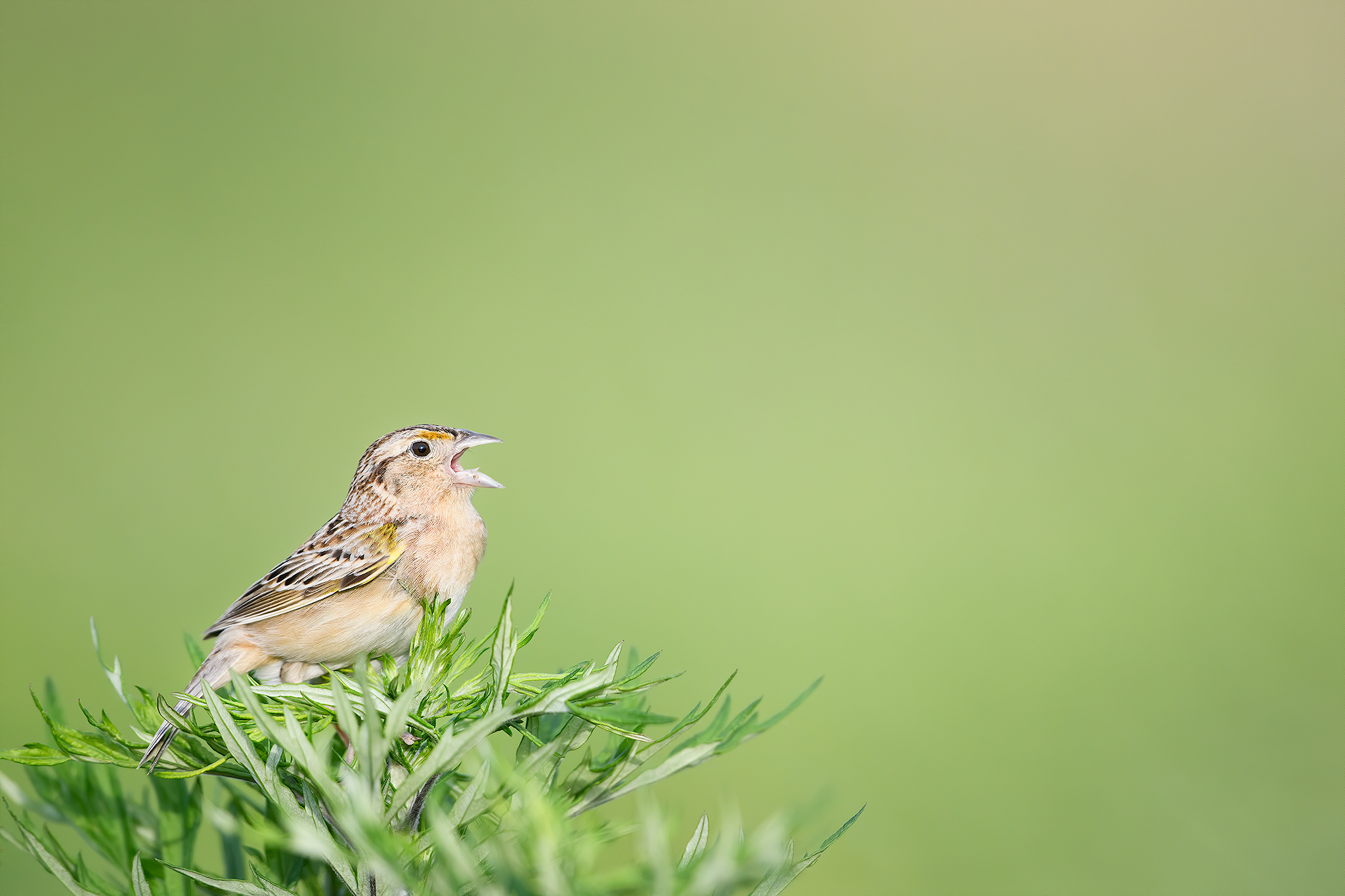
Grasshopper Sparrow on Milkweed – Nikon D850, NIKKOR 500mm f/4G VR – f/4.0 – 1/4000 – ISO 800
How I Got the Shot:
With any wildlife photography, I recommend a starting lens no less than 300mm. A basic 70-300mm kit lens will suffice. That being said, if there’s one type of bird that pushes us to longer focal lengths, it’s songbirds. An APS-C, or “cropped”, sensor paired with such a zoom will provide some relief, though you’ll learn quickly if a longer lens is needed. I was shooting with a 500mm prime lens for most of my outings with these birds. I found this lens paired with a full frame DSLR just long enough to get the results I was after. I personally like some empty space in my images, but it’s a look that’s not for everyone. Someone equipped with a 600mm lens and an APS-C body would have gotten much closer results.
Next comes lighting. I always recommend shooting in the first hours of daylight or the last few with the sun either to my back or facing me directly. This varies on what effect I’m going for with my images. More often than not, you’ll want the sun on your back as it is in the image above. We call this shooting on “Sun-angle”. Shooting in these hours not only provides the most pleasing light, it also happens to be cooler, which in turn, makes for active wildlife. It’s also worth shooting when the sun isn’t visible at all. Overcast days provide soft, diffuse light that can be pleasing throughout the day. In fact, I prefer to shoot on these days for most other songbirds I photograph.
As this species prefers life on the ground, finding one in the open was quite the challenge. As luck would have it, this patch of grassland habitat harbored a number of singing males. This resulted in territorial skirmishes between neighboring birds. Once a male had successfully chased the intruder off, it would perch atop a grass stalk and sing. The height of the grass allowed me to crouch down and remain almost invisible from the height of the sparrow. As this is not a heavily visited location, the birds were not accustomed to human presence. I had to tread carefully. Once in position, I remained in the area for much of the evening. By sitting as still as possible, I managed to photograph three individual males.
As stated above, if there’s one time and place you want the longest lens possible, it’s here. Songbirds, especially these sparrows, are small and skittish. As stated above, I spent most of the shoot crouching along the fields edge to stay hidden. I also got low as to shoot from my subjects eye-level. Being at the same level as your subject is essential to engaging your audience. It’s scenarios like these where super-telephoto zooms are ideal. If the bird comes closer, you can always zoom out without moving and startling the bird. These lenses also tend to be lighter than their prime counterparts, although new mirrorless lenses as well as Nikon’s Phased Fresnel optics are narrowing the margin.
A major aspect I made sure to check before situating myself, was the backgrounds. I made sure to keep an eye out for bright objects in the distance. Any one distracting element can throw the whole composition off, and I try to avoid removing spots in post as much as possible. A wide aperture and the vast field ultimately made for a nice, smooth background. Remember, the farther away the background, the blurrier it will become. As long as you’re using a long lens, this occurs regardless of aperture.
Once I was set up, I could begin thinking about positioning the bird in the frame. If you’ve attended one of my focus sessions at BCC, you’ve heard me talk about the rule of thirds time and time again. This is for good reason. All too often I see images with the bird or animal smack dab in the middle of the frame. There is a time and place for this, but more often than not, it’s not ideal. By positioning the bird in the lower right third of this image, it gives a sense of space. The bird is singing into the emptiness of the frame, allowing the viewer to imagine what lies ahead. This empty space is often referred to as “dead” space. Learn to use it well, and you’ll be on the path to strong compositions. If you can’t do this in the heat of the moment, remember, you can always crop in post. The beauty of modern cameras is their resolution. You can crop with little to no image degradation. I would be lying if I said I nailed the composition in-camera every time. I crop most if not all of my images to some degree.
Lastly, always prioritize the well-being of your subject. Allow space for the birds to feed, sing, and go about their business uninterrupted. Don’t panic if you accidentally flush a bird. We’ve all done it. Learn from it and avoid doing so in the future. Where applicable, stay on designated trails and respect boundaries. Wildlife refuges and parks are riddled with trails and roads for authority and park staff use. Authorized personnel signs mean authorized personnel only. Do not enter. Where trails are narrow or simply do not exist, watch your step. Many animals, not just the Grasshopper Sparrow, nest on the ground and don’t shy away from leaving young on or near trails. Be careful, wear your sunscreen and insect repellent, but also have fun with it.
If you’re interested in learning more about my bird photography techniques and outings, click here for more. We will be adding in-the-field workshops to our website in the near future, so stay tuned. Sign up for our weekly newsletter for updates.
Welcome to our thirty-first Bergen County Camera Customer Spotlight. This monthly posting features a customer who’s made an impression on us. They might have grown in their understanding of photography, gained a mastery of the craft and / or have become a strong advocate of our way of doing business in the world of photography. During the next month you will see this customer’s images displayed on our digital signs in store, in our emails, blog posts and social media.
John Kingston is our customer spotlight for the month of August. We hope you both enjoy and are inspired by this new addition to In Focus and look forward to your comments and suggestions. Below you will find a word from John, followed by some of his images in the gallery below.
Jean Fruth will be visiting Bergen County Camera in Westwood, NJ on Thursday, July 28th from 6 pm – 9 pm for a talk and book signing. At the center of this event is her new book “Grassroots baseball – photographs by Jean Fruth” You can meet Jean Fruth and have your book[s] personalized at this free event. No purchase is required to attend either of these events.
6 pm – 7 pm – Jean will present a short talk on the book
7 pm – 9 pm – Book signing with Jean Fruth
We hope you can join us for Jean Fruth’s Grassroots Baseball – Route 66 edition.
About the book: Grassroots baseball – photographs by Jean Fruth
Hardcover – 256 pages – $70 Purchase is not required to attend this free event.
“I’ve learned that the game is more than just a sport – it is dreams and aspirations for so many youngsters wherever I go. The culture of baseball is so much bigger than just what happens on the field.”
Jean Fruth Bio
Sports Photographer Jean Fruth does more than take pictures. She tells stories — of vibrant personalities, local cultures, and distinctive communities. From a small darkroom to the most iconic stadiums flooded with lights, Jean’s trajectory as one of photography’s preeminent visual storytellers has taken her on a round-the-horn tour of the world’s most indelible landmarks – from the world of baseball to the world at large. Sports have always been Jean’s most compelling subject, and from her earliest days in sports photography, she covered everything from wrestling to sailing to basketball — and on any given Friday, she could be found taking full advantage of those Friday night lights, shooting northern California’s storied football rivalries.
Soon Jean was called up to the big leagues herself, as she spent nearly a decade shooting the crown jewels of Bay Area sports — the Giants, the A’s, the 49ers. Her portfolio quickly expanded when she was invited to Cooperstown and the National Baseball Hall of Fame & Museum, where she helped build the museum’s archive and bring to life the story of baseball. America’s most eminent historical institutions – including the Abraham Lincoln Presidential Museum and the Smithsonian — have featured her work.
What drives Jean now is to serve communities through her storytelling – as the co-founder of Grassroots Baseball, a non-profit that promotes participation in baseball at the youngest levels, and as a traveling photographer for La Vida Baseball and La Vida Sports, digital media companies that shares the stories of Latino sports around the globe. As one of Sony’s select Artisans of Imagery, and through her popular workshops, she shares her techniques, her insights, and her love of images — both the power of pictures and the stories they tell.
Jean’s first book, Grassroots Baseball: Where Legends Begin, was released in 2019. Her latest, Grassroots Baseball: Route 66, was just released in June 2022, with proceeds benefitting the non-profit program.
Thanks to all who came out to for the overwhelming reception given George Tice and his daughters Lisa and Jennifer ! The June 2nd Lifework book signing sold every copy in stock and a good portion of the replacement order that’s due to arrive soon.
We’ve heard from many who’d like to have attended, and due to the great success, and how much everybody, including the Tices , enjoyed themselves and Lifework the Tices are looking forward to a repeat visit! The “Second Signing” at Gallery 270 is on Thursday July 21 from 7-9PM . You can sign up now on Eventbrite and pre order the books that George can then personalize for you.
George Tice will be visiting Gallery 270 in Westwood, NJ on Thursday July 21st from 7 pm – 9 pm for a book signing. At the center of this event is his new book “Lifework – Photographs 1953 – 2013.” You can meet George Tice and his daughters Lisa and Jennifer and have your book[s] personalized at this free event on Thursday, June 2 from 7 pm – 9 pm. In addition to George’s latest book, Gallery 270 will have other Tice titles on display and available for purchase.
About the book Lifework chronicles the extraordinary career of George Tice, one of the most celebrated American photographers of the modern age. Beginning with his photographs of The Bowery in the early fifties, Tice has used his camera to document the people and places of everyday America that often go overlooked. This beautiful hardbound book contains photographs from all of Tice’s major bodies of work, as well as images that have never been published.