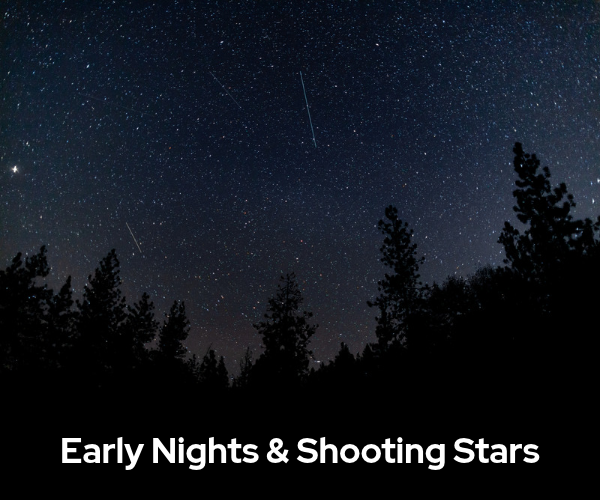
Look Up: Catching the Taurid Meteor Shower
Since the clocks fell back on Sunday 11/1, it’s been dark by the time most of us get home, and this week that’s actually good news. The Taurid meteor shower is underway, and it’s known for slow, bright meteors that occasionally flare into fireballs. Plus, the new moon on November 9 means the darkest skies of the month will be lining up with the Taurid shower. The Taurids don’t put on a constant show, so you’ll need a little patience to capture the magic. Give it some time, and you might catch a fireball drifting across the New Jersey sky.
Read more for when and where to look, what to expect, and how to photograph it from close to home!
What are the Taurids?
The Taurids are two meteor showers, the South Taurids and the North Taurids, that overlap every fall. Both Taurids are named for the constellation Taurus the Bull. The debris that creates them is tied to Comet Encke, which has the shortest orbit of any major comet in our solar system and circles the sun about every 3.3 years. Taurid meteors tend to move slowly across the sky, and some are bright enough to count as fireballs, which is what makes this shower fun to watch even though it isn’t one of the busiest of the year.
When to Look
The South Taurids are predicted to peak on Thursday, November 5, and the North Taurids on Thursday, November 12. Neither shower has a sharp peak, so you don’t need to circle a single night on the calendar. The best stretch this year may be the weekend of November 7 and 8, when the moon is nearly new and the sky is at its darkest, with the new moon itself arriving early on Monday, November 9. Taurus rises in the east in the early evening and climbs highest in the sky around midnight, so the hours around midnight are the best time to watch.
Where to Go
Here in Bergen County, the glow from New York City is our biggest obstacle, but the good news is that Taurid fireballs should be bright enough to catch even from the suburbs. Start close to home: a backyard or open field with the lights off and an open sky view works well. Face north or straight overhead, and give your eyes 20 to 30 minutes to adjust to the darkness before you decide it’s not working. The darker skies of northwest New Jersey, in Sussex and Warren Counties, can make a real difference. Before you head out, though, check the park’s hours – many state parks close at sunset.
What to Expect
Set your expectations honestly: the Taurids are a slow, steady shower, not a dramatic one. Under truly dark skies with no moon, each stream produces about five meteors an hour, or around ten when they overlap like they do now. From the suburbs, you’ll likely see fewer. In a typical year only about 1 percent of Taurid meteors are fireballs, and astronomers aren’t predicting a special fireball swarm this year (the next one is expected in 2032). So bundle up, bring a chair, and give it at least an hour. Taurid meteors move slowly enough that when a bright one does appear, you’ll have time to point it out to whoever’s next to you.
Photography Tips and Gear
Photographing meteors is mostly a numbers game: set up, point your camera at a dark patch of sky, and let it take picture after picture (try burst mode). Use your widest lens at its widest aperture, and focus manually by zooming in on a bright star in live view, since autofocus won’t lock in the dark. A good starting point is ISO 1600 to 3200 with exposures of 15 to 25 seconds, short enough to keep the stars from streaking. Shoot in RAW, and turn off long-exposure noise reduction so the camera doesn’t leave gaps between frames when a meteor might cross. Aim about halfway up the sky, a little away from Taurus rather than right at it. You can also try to include a treeline, barn, or ridge for a sense of place and more composed photo.
For gear, a sturdy tripod matters most, followed by an remote that keeps the camera shooting on its own. A fast wide-angle lens helps a lot, and a red-light headlamp lets you adjust settings without ruining your night vision. Cold November nights drain batteries quickly, so keep a spare in an inside pocket to help keep it warm. If you’re not sure what you need, or want help setting up your camera, stop by and we’ll walk you through it.
What’s Next in the Night Sky
If the Taurids get you hooked on astrophotography, there’s plenty more coming. The Leonids peak overnight November 17 into 18, with Jupiter and Mars shining close together, a great setup for a wide-angle shot. The Geminids, one of the best showers of the year, peak December 13 into 14, with up to 120 meteors an hour under dark skies. After that come the Ursids around December 21 and 22, and the Quadrantids before dawn on January 4. Each one is a good chance to practice, and we’d love to see what you capture!