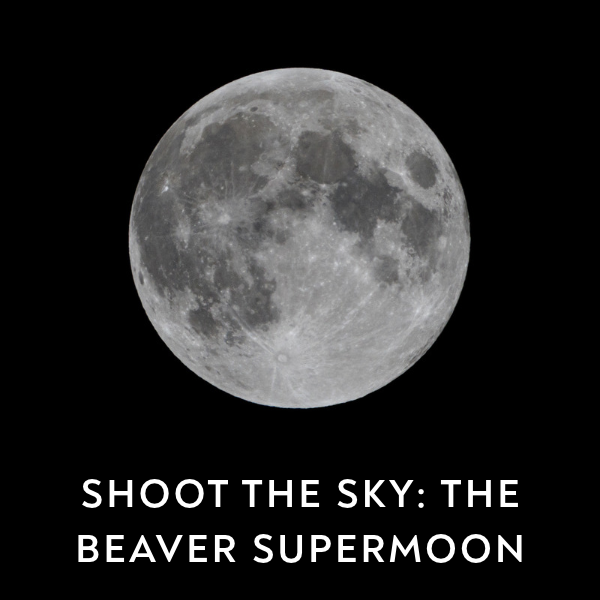
Shoot the Sky: The Beaver Supermoon
Two days before Thanksgiving, the full moon is going to put on a show. November’s full Beaver Moon is a supermoon this year. Supermoons appear a little bigger and brighter than an average full moon, and it will rise right around sunset on Tuesday, November 24. If you’ve ever wanted to photograph a big, glowing moon coming up over the horizon, this is a great week to try to perfect your technique!
Read on for when and where to look, what to expect, and how to photograph it from the tri-state area
Shoot the Sky: The Beaver Supermoon
What is a ‘Supermoon’?
The moon’s orbit isn’t a perfect circle, so the distance from Earth changes throughout the month. A ‘supermoon’ happens when a full moon also lines up with the moon’s closest approach to Earth. This one will be about 224,170 miles away, close enough to look ~6.5 percent larger and 13.5 percent brighter than an average full moon. It’s also called the Beaver Moon, a traditional name for November’s full moon as a nod to the time of year when beavers finish their lodges before winter.
When to Look Up
The moon is technically full at 9:53 AM on Tuesday, November 24 – but it will still be below our horizon. Plan to look up on Tuesday evening: in the New York City area, the moon rises at about 4:15 PM, just before sunset. Monday evening will also work well, with the moon rising a little earlier and looking just as full. Plan to be in position a few minutes before the moonrise. While the moon is still low and the sky is glowing from sunset it is a great time to watch and photograph.
Where to Go
The full moon rises in the east-northeast, so look for a spot with a clear, low view in that direction. It’s always a good idea to plan some locations beforehand, so you are ready to go. Trees and buildings near the horizon will hide the moon for the first several minutes, and that’s the part you most want to see with the sunset glow. Closer to home, an open field, a high parking deck, or a hilltop park with an eastern view can work just as well.
What to Expect
First – set your expectations correctly. You probably won’t notice the extra size on its own, since the difference is relatively small. What you will notice is how big and dramatic the moon looks right at moonrise. When the moon sits low near the horizon, especially next to trees or buildings, it seems much larger than when it’s high overhead. The moon can also tend to look golden or orange as it rises, which can make for striking photographs. As it climbs higher, it turns brighter white, and later in the evening it’s bright enough to cast shadows.
Photography Tips and Gear
The classic supermoon shot is a big moon rising behind a landmark, and the trick is distance. Use a long lens, anywhere from 200mm to 600mm, and stand far back from your landmark. The farther away you are, the larger the moon looks next to it. Put the camera on a tripod and focus manually by magnifying the edge of the moon in live view. The moon is much brighter than most people expect, so expose for the moon, not the sky: try ISO 200, f/8, and around 1/125 second, then check your screen and adjust. Right at moonrise, the sky still holds some light from sunset, so you can capture detail in both the moon and the landscape. Wait too long and the foreground goes dark. Shoot in RAW and take plenty of frames as the moon climbs. With a phone, zoom in, tap on the moon to focus, then slide the brightness down until you can see detail on its surface.
For gear, a sturdy tripod and a telephoto lens matter most, and a teleconverter can add extra reach to a lens you already own. A remote or the self-timer helps you avoid shake at long focal lengths. November evenings get cold fast once the sun goes down, so dress warmly and keep a spare battery in an inside pocket.
Not sure which lens to bring, or want help with settings? Stop by and we’ll help you get set up.
If It’s Cloudy
Check the forecast and pick the clearest evening, since Monday works nearly as well as Tuesday. Clouds right along the eastern horizon can block the moonrise even when the rest of the sky looks clear, so it’s worth giving yourself a little extra time. A few scattered clouds can actually help, adding texture and drama as the moon slips between them. If both nights are cloudy, don’t worry: you’ll get two more chances this winter.